
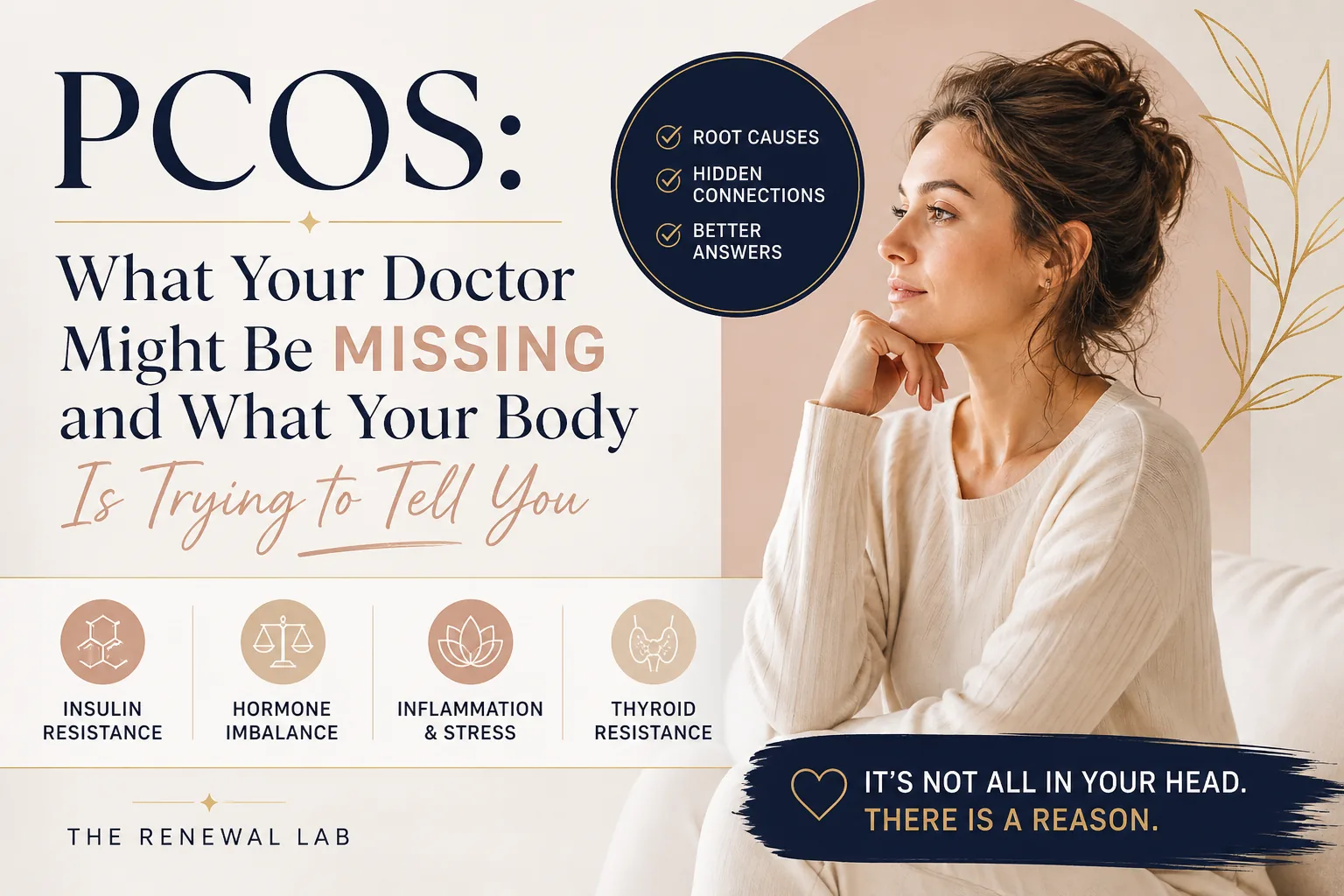
If you have been told you have PCOS, or you think you might, you have probably felt this before:
Something is not right, but no one is really explaining why.
You may have been given a prescription, told to lose weight, or reassured that your labs are normal. And if you have struggled with weight or getting pregnant, there is a good chance the blame has been placed on you.
You may have been made to feel like you are not trying hard enough, not disciplined enough, or somehow doing something wrong.
And yet, you are doing everything you can and still not getting answers.
"You are not imagining it. And this is not your fault."
Let's talk about what PCOS actually is — and what is really driving it.
What Is PCOS Really?
Polycystic Ovary Syndrome is often treated like an issue with the ovaries.
It is not.
PCOS is primarily a metabolic and endocrine condition, and for many people, it is driven by insulin resistance.
When this piece is missed, everything else becomes harder to understand — and even harder to treat.
Common PCOS Symptoms
PCOS does not look the same for everyone, which is part of why it is so often misunderstood. Common symptoms include:
- Irregular or missing periods
- Painful periods
- Severe PMS
- Difficulty getting pregnant or not ovulating regularly
- Weight gain, especially around the abdomen
- Acne that does not improve
- Excess facial or body hair
- Thinning hair or hair loss on the scalp
- Fatigue or low energy
- Brain fog
- Mood changes such as anxiety or depression
- Cravings, especially for sugar or carbohydrates
- Darkening of the skin around the neck, groin, or armpits
These symptoms are often treated as separate issues. They are not separate. They are connected.
What Causes PCOS?
PCOS is not random. It is driven by underlying dysfunction, most commonly insulin resistance.
Insulin Resistance and Hormone Disruption
When insulin levels and blood sugar levels rise, the body produces less sex hormone binding globulin. This matters because sex hormone binding globulin helps regulate how much active hormone is circulating in the body.
When levels drop, more free androgens are available. This contributes to acne, excess hair growth, and irregular cycles.
Insulin resistance is not just part of the problem. For many people, it is the main driver.
It is also a major reason why acne and hirsutism develop in the first place — even though those symptoms are often treated as purely hormonal or skin-related issues.
At the same time, insulin resistance can contribute to elevated estradiol levels. When estradiol is elevated, it can further disrupt the hormonal environment, contributing to mood swings, more severe PMS, difficulty ovulating, and infertility. This is where many people start to feel like their hormones are completely out of control — when in reality, there is a metabolic driver underneath it all.
Hormonal Imbalance
Higher androgen levels are a hallmark of PCOS. But this imbalance is often a downstream effect, not the starting point.
When insulin resistance is present and sex hormone binding globulin is low, more active hormones circulate in the body. This creates the hormonal picture many people are told they have — without ever being told why it is happening.
Chronic Inflammation
Inflammation can worsen insulin resistance and interfere with hormone signaling. It can also contribute to fatigue, weight changes, and difficulty with ovulation. For many people, this is an important but often overlooked piece.
Stress and Cortisol
Chronic stress affects blood sugar regulation and hormone balance. When cortisol remains elevated, it can worsen insulin resistance and make it harder for the body to ovulate regularly. This is one reason people can feel like they are doing everything right but still not seeing progress.
Thyroid Hormone Resistance
Many people with PCOS experience symptoms that sound like low thyroid function — fatigue, low energy, brain fog, hair changes, and weight struggles. Yet their labs are often reported as normal.
In many cases, this is due to thyroid hormone resistance, meaning the body is not responding to thyroid hormone effectively at the cellular level. So even when numbers look acceptable, the body is still not functioning optimally.
Why Traditional Treatment Often Falls Short
Many people with PCOS are offered birth control or medications to help with blood sugar. These options can have a role, but they often do not address what is actually driving the condition.
Birth control may regulate bleeding, but it does not restore natural ovulation or correct the underlying metabolic issues. Medications may help improve insulin sensitivity, but they are often not enough on their own.
And being told to lose weight without understanding what is causing the weight gain in the first place is not a real solution.
A Different Way to Look at PCOS
Your symptoms are not random. They are signals.
When insulin resistance is addressed, many of the downstream hormone imbalances begin to shift. When the metabolic side of PCOS is supported, the body is better able to regulate hormones, ovulate, and function as it should.
This is a very different approach than simply managing symptoms.
Final Thoughts
PCOS is not just about the ovaries. It is not just about hormones.
And it is not something you should have to navigate without real answers.
Your symptoms are connected. Your experience is valid. And there is a reason your body feels the way it does.
"It's not all in your head. There is a reason."