
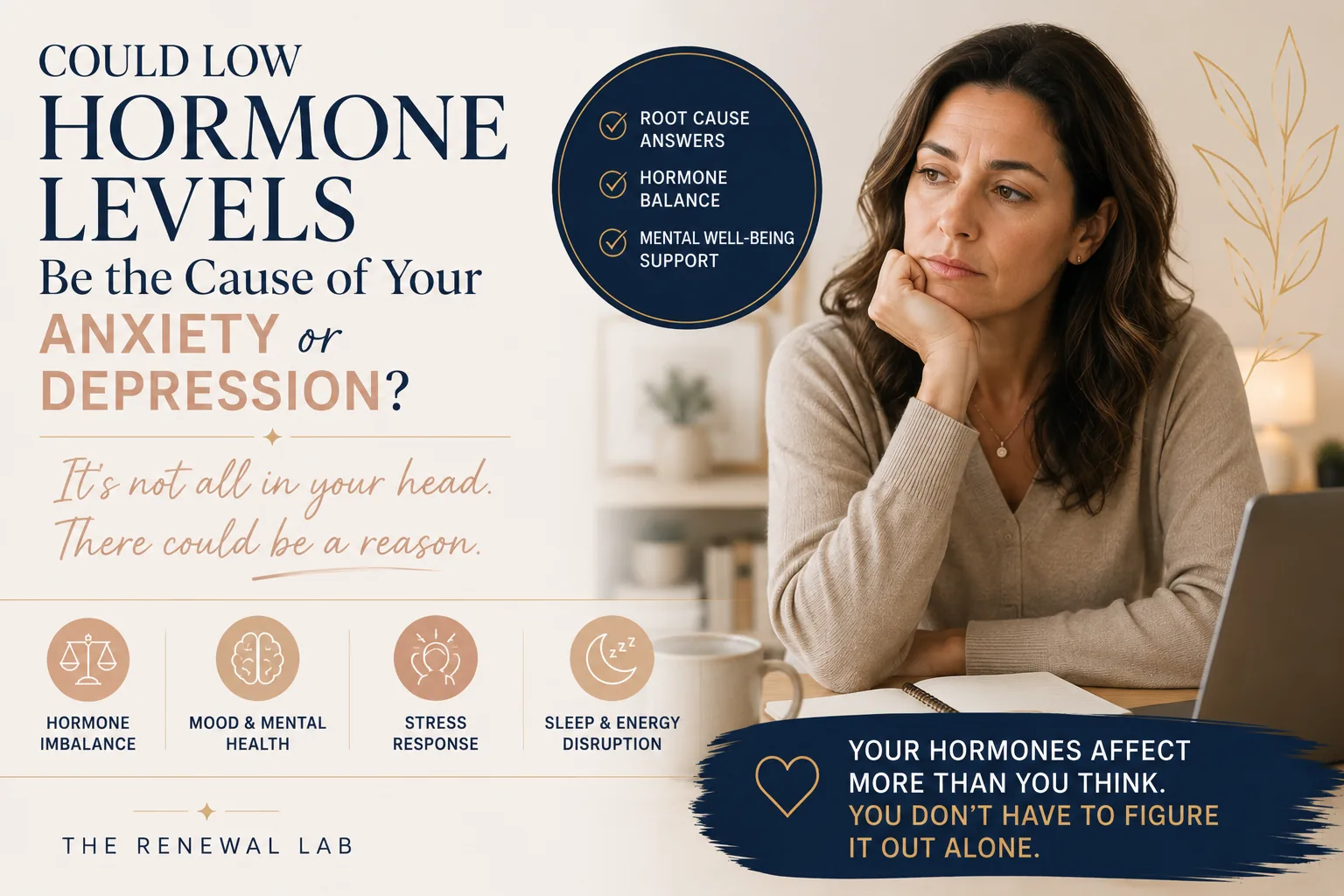
You're Not Crazy… But You Might Be Missing a Piece
If you've been struggling with anxiety, depression, or both — and nothing seems to fully make sense — you're not alone.
I see this all the time. People are doing everything they can to feel better, but something still feels off.
"Mental health is not just 'in your head.' Your brain is part of your body, and it responds directly to your hormones."
The Mind and Body Are Not Separate
Your brain is part of your body, and it responds directly to your hormones. Hormones like:
- Estradiol
- Progesterone
- Testosterone
- DHEA
- Thyroid hormones
All play a major role in how you feel emotionally and mentally. When they are out of balance, your mood often follows.
How Hormones Affect Anxiety and Depression
Estradiol
Estradiol has a powerful effect on brain chemistry. It helps regulate neurotransmitters like serotonin and dopamine, which directly impact mood.
When estradiol drops, people often experience:
- Increased anxiety
- Low mood
- Irritability
- Brain fog
But it's not just about low levels. When estradiol is too high relative to other hormones, you may also feel:
- Emotional
- Irritable
- Anxious
- Overwhelmed
Balance matters.
Progesterone
Progesterone has a calming, stabilizing effect on the brain. It supports sleep and helps regulate the nervous system.
Low progesterone can show up as:
- Anxiety
- Trouble sleeping
- Feeling 'on edge'
- Difficulty relaxing
But too much progesterone isn't always the answer either. Higher levels can sometimes make people feel:
- Weepy
- Emotionally sensitive
- Flat or disconnected
Again, this comes back to balance.
Testosterone
Testosterone is often overlooked when it comes to mental health. But it plays a major role in:
- Motivation
- Confidence
- Mood stability
- Energy
Low testosterone can feel like:
- Low mood
- Lack of drive
- Brain fog
- Feeling unlike yourself
DHEA
DHEA is a precursor hormone that helps support both testosterone and other hormone pathways. It also plays a role in resilience, energy, and overall sense of well-being.
When DHEA is low, people often report:
- Fatigue
- Low mood
- Decreased stress tolerance
- Feeling run down
Thyroid Hormones
Your thyroid affects far more than metabolism. It plays a major role in brain function and mood.
When thyroid hormones are not optimal, you may experience:
- Depression
- Low energy
- Brain fog
- Slowed thinking
And as you already know, this is one of the most commonly missed issues.
Why This Gets Overlooked
I'm going to be very direct here. Most people struggling with anxiety or depression are never evaluated from a hormonal perspective.
They are often told to take an SSRI and go to therapy. But if hormones are part of the problem — and no one is looking at them — then a major piece is being missed.
This Is Not All in Your Head
If your hormones are out of balance, how you feel is going to change. Anxiety and depression are often treated without looking at what's happening underneath.
Hormones are a major part of that picture.
My Approach
I don't separate mental health from physical health — because they are deeply connected.
When I see patients struggling with anxiety or depression, I look at the full picture, including hormones. At The Renewal Lab, I use bioidentical hormone replacement therapy (BHRT) when appropriate to help restore balance.
Because when your hormones are supported, your brain is supported.
The Bottom Line
If you're struggling with anxiety or depression and feel like something is being missed… you're probably right.
Low or imbalanced hormones can absolutely play a role in how you feel. When you address that, things can start to shift in a way that finally makes sense.
You don't have to settle for feeling this way.
There Could Be a Reason
Your Hormones Affect More Than You Think
At The Renewal Lab, we look at the full picture — including the hormonal side of mental health.
Book a Consultation